Solutions
Five integrated solutions to modernize drought assessment and build resilience across the Northern Great Plains.
NGP RIDR is organized around five integrated solutions. Each addresses a distinct challenge in how drought is assessed, communicated, and acted upon.
Solution 1: Regional Drought Assessment Framework
Goal: Establish buy-in across all five Northern Great Plains states for a shared regional drought assessment framework, including vulnerability assessment, indicator selection, defined reference periods, expanded impact assessment, and a shared governance structure.
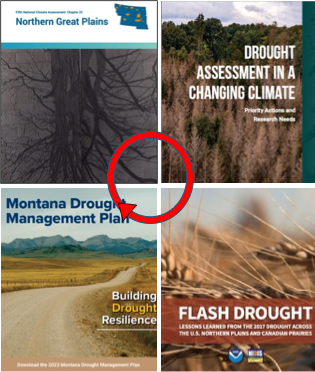
The Northern Great Plains has no unified drought assessment system. Different states use different indicators, different historical baselines, and different processes — and those inconsistencies have real consequences when federal programs, insurance triggers, and emergency declarations depend on drought classifications.
NGP RIDR will develop a regional drought assessment framework (not a management plan) that aligns states on:
- Indicators and datasets grounded in water-balance science
- Reference periods that account for non-stationarity in climate
- Explicit methods for assessing drought vulnerability and impacts
- A shared governance structure for assessment, conflict resolution, and future updates
The framework will be built with and for state agencies, Tribal nations, rural communities, and federal partners.
Lead: Britt Parker (NIDIS) | Co-leads: Michael Downey (MT DNRC), Jason Gerlich (NIDIS)
Solution 2: Next Generation Water Balance Monitoring
Goal: Shift from proxy indices to direct water-balance indicators using knowledge-guided machine learning to improve estimates, correct structural model bias, enable scalable simulations, and provide true early warning.
Current drought monitoring relies heavily on proxy indices derived from precipitation and temperature — metrics that can miss flash droughts, mischaracterize soil moisture conditions, and lose accuracy as climate patterns shift. The solution is not a better index: it’s a shift to directly estimating the water balance.
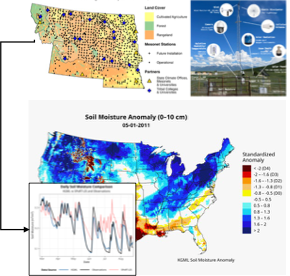
NGP RIDR will leverage:
- Dense mesonet networks already deployed across the region — particularly soil moisture sensors — as direct observational anchors
- Knowledge-guided machine learning (KGML) to improve estimates of soil moisture, groundwater, surface water, and evapotranspiration; correct structural model bias; and enable fast, scalable, reproducible simulations
- 7- and 14-day forecast integration to provide genuine early warning, not just retrospective assessment
The 2017 Northern Plains flash drought is a benchmark: the new system must demonstrate it can detect events like that earlier and more accurately than existing approaches.
Lead: Zach Hoylman (UM) | Co-leads: Nathan Edwards (SD Mesonet), Julian Scott (BLM)
Solution 3: Integrated Regional Drought Data Services
Goal: Develop open, accessible, authoritative dashboards grounded in peer-reviewed science, supporting multiple audiences while avoiding dashboard overload and clearly distinguishing drought conditions from impacts.
The region already has too many drought dashboards — each built for a specific audience, using different data and methods, with inconsistent outputs. The result is confusion, not clarity.
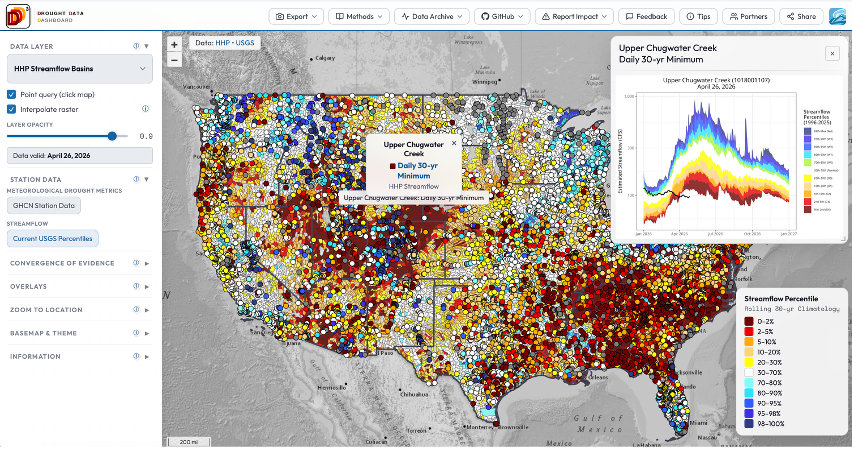
NGP RIDR will co-produce a regional drought data service with the communities and agencies it’s meant to serve. Dashboards will:
- Be objective, transparent, and reproducible — with documented data sources, methods, and reference periods
- Support multiple audiences: state agencies, Tribal nations, agricultural producers, utilities, emergency managers
- Allow tailoring by geography and sector (e.g., weighting soil moisture for rangelands vs. streamflow for irrigation)
- Clearly distinguish drought conditions (water balance) from drought impacts (agricultural, economic, ecological, cultural)
- Be designed for adoption by other regions — making the NGP RIDR system a national incubator, not just a regional one
- Can be customizable for subregions (states) in their specific needs.
Lead: Kelsey Jencso (UM) | Co-leads: Julian Scott (BLM), Kyle Bocinsky (UM), Laura Edwards (SD SCO), Michael Downey (MT DNRC)
Solution 4: Drought Risk & Adaptation
Goal: Align drought science with insurance and risk frameworks that influence USDA payments and disaster aid, engaging public and private sector risk practitioners early to improve incentives for adaptation.
Drought classification directly affects billions of dollars in USDA program payments — Livestock Forage Program (LFP), Livestock Indemnity Program (LIP), Emergency Loan programs — and private crop and livestock insurance. Yet the drought science used to trigger these programs often relies on outdated baselines that don’t reflect a changing climate.
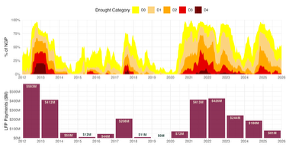
NGP RIDR will:
- Learn from insurance and risk practitioners — not attempt to reinvent their frameworks
- Identify where improved drought science can reduce mismatches between actual conditions and program triggers
- Develop a pilot for agricultural risk alignment that demonstrates how nonstationary, water-balance-based assessment improves incentives for adaptation
- Engage USDA (FSA, RMA), private insurers, ag lenders, and risk modelers as early co-producers
This solution treats the insurance and disaster-aid ecosystem as a partner, not an audience.
Lead: Kyle Bocinsky (UM) | Co-leads: Laura Edwards (SD SCO), Zach Hoylman (UM)
Solution 5: Tribal and Rural Drought Workforce Development
Goal: Ensure tribal data sovereignty while creating clear pathways for tribal input into drought assessment, including tribal-facing dashboards, workforce development, and sustained, funded engagement.
Many of the mesonet stations that anchor the new water-balance monitoring system sit on Tribal lands. That creates a responsibility — and an opportunity. NGP RIDR is committed to ensuring that the data generated on tribal lands benefit tribal communities, and that Tribal nations have genuine agency in how drought affecting their lands and people is assessed and communicated.
NGP RIDR will work with Tribal colleges (TCUs), the FALCON network, the Great Plains Tribal Water Alliance, and individual tribal nations to:
- Develop tribal-specific or tribal-facing drought dashboards that reflect tribal priorities, data, and decision contexts
- Create workforce development pathways — certificates, internships, network maintenance roles — that build lasting drought monitoring capacity in tribal communities
- Establish official, defined input pipelines that give Tribal nations a direct voice in regional drought designation processes
- Build sustained, funded engagement — not the unfunded expectations that have characterized so many past collaborations
Lead: Kyle Bocinsky (UM) | Co-leads: Nathan Edwards (SD Mesonet), Laura Edwards (SD SCO), Carrie Schumacher (AIHEC/FALCON)